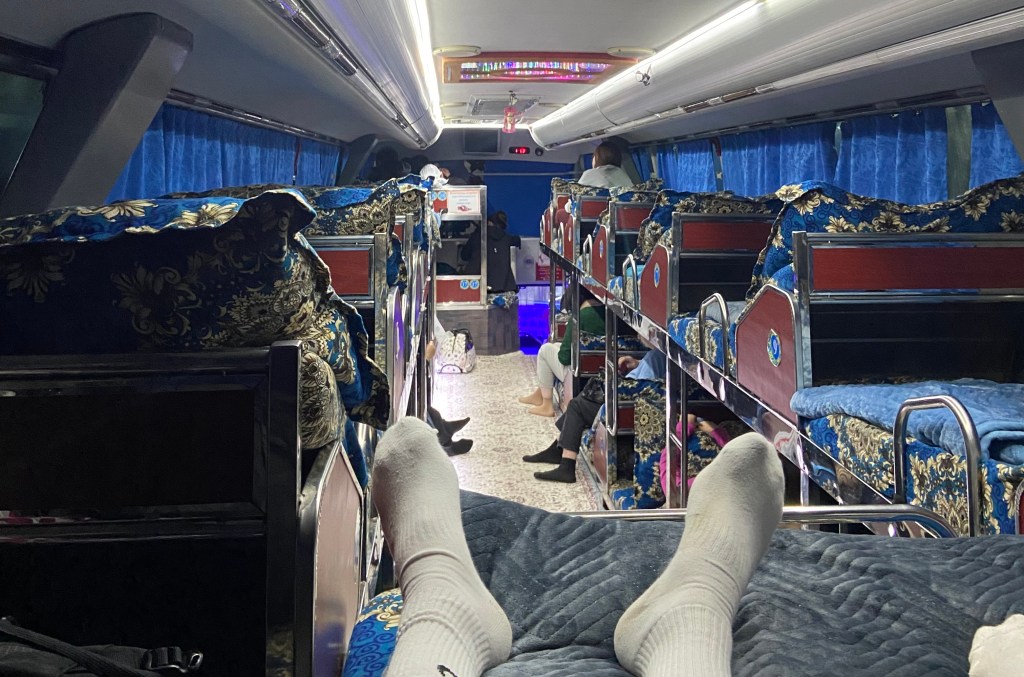
I drifted out of sleep as the sun began to rise. I peeked through the bus curtains at highway and steppe. The landscape resembled that around Almaty, where we had departed from fourteen hours earlier. Google Maps situated us just miles from the Kazakhstan / Uzbekistan border as the bus rolled to a stop and the driver got out to smoke a cigarette. He got back in a few minutes later and the bus growled to a start. We kept on, circling Tashkent on the Kazakh side of the border.
Some miles later, the circling stopped. We were on the highway, going straight. Jonas and I looked at each other. The cigarette break was our stop, and now we were flying down the highway in the wrong direction. With each passing second civilization crept further back in the rearview. When the driver took his next cigarette break, we hurried to the front of the bus, put our shoes back on, and asked for our bags. He opened the storage compartments and, gruffly, gave us the name of the border crossing, and instructed us not to spend more than 2,000 tenge getting there.
The bus left us standing on the side of the road. We waited to cross as a man on a wagon pulled by a donkey meandered by. It was a warm morning. I pulled out a pastry I had packed as Jonas tried to find a taxi on his phone. He waited five minutes. No takers. I tried mine and we both waited another ten. Nothing. The border was a ten-mile walk away. We stuck out our thumbs.
Soon after, a car pulled off and we got in. There was another Kazakh man in the front seat. We told him our destination and he took off in the right direction. A few minutes later, the car pulled over again. Jonas scooted into the middle seat, we picked up another passenger, and we kept going. A little while after that, both passengers took to the curb. They handed our driver some change on the way out. Our next stop was the border. We made it, and I handed our driver what little tenge I had left—2,000. After a bumpy morning, there we were: the Kazakh / Uzbek border.
We walked down a long street lined with people. They didn’t seem to be coming or going, just standing. Many were taxi drivers. We walked by without acknowledgment. We made it to the Kazakh side, showed our passports, scanned our bags, and passed through. From there, we entered no man’s land. We crossed a river lined on each side by multiple layers of barbed-wire fences and walked through the large gates challenging us to enter Uzbekistan. Jonas took his spot in line and I stepped in behind him. He got to the window, handed over his passport, got a stamp, and walked through. I handed over my passport and situated myself in front of the camera waiting to add a stamp to my collection. It didn’t come. Instead, the border officer asked “Visa?”
I stared blankly after him. My usual “niet Ruski, tourist. Angliski” wouldn’t work here. I think I asked if Americans need visas. Then I Googled it. The answer: yes. Shit. I had double-checked Tajikistan and Kyrgyzstan but somehow forgot our first stop. He took me aside where we met with four other Uzbek border officers. One spoke English. He confirmed my need for a visa and informed me that I could apply online. I opened the application. No, he explained. It takes three days. I told him that I would go back to Kazakhstan and apply. I crossed back over the river, handed my passport back to the Kazakh officer, and was stamped back into Kazakhstan.
Twenty minutes later, I was one of the people loitering outside of the gates. I now had three days to kill. I imagined myself shacking up at a local hotel, burning through Netflix’s library, and maybe finishing my book. I had just come fourteen hours from Almaty. Returning was not an option. Worse, I had no cash. With no other obvious choice, I walked into the nearest—and only—hotel and asked how much a night would cost. I was told sixty dollars and walked back out. I spent the next hour walking around with backpacks on my chest and back in search of either a hotel or an ATM. None of either. I found a seat in the shade.
I had planned for the data on my esim to run out just as I crossed the border, so I first had to hope I would have enough to load the refill website. I did. Next, I opened Google Maps and typed in “hotel.” Nothing. I zoomed out—still nothing. I zoomed out again and saw “Shymkent” written a little ways back in the opposite direction. Shymkent had hotels. Better yet, it had hostels. Unfortunately, Shymkent was two hours away.
A Google search revealed that the only way to Shymkent from the border was via shared taxi. With no cash and no ATM, that was not an option. I rummaged through my backpack for my other wallet and coin purse. I found one hundred New Zealand dollars, some Kyrgyz Som, some Kazakh and Australian coins, and a five Euro note. There were no ATMs in sight, but nearly every shop window was illuminated with foreign exchange rates. I tried the first window I found. I slid my five euros under the glass. The teller looked at it and slid it back, shaking her head. I tried three more windows with the same result. I tried the New Zealand money at another—no luck. I crossed the street to try again. I found a small window and handed an older woman my humble five-euro note. She typed into her calculator and showed me the result: 2,500 tenge. I nodded “harasho” and she handed me the Tenge.
I turned back across the street to a woman standing in front of a bus and yelling at me. “Almaty?” she asked. I had no interest in another 14-hour bus ride. “Niet. Shymkent.” She turned to a man by her side and they talked for a moment. “Shymkent, da,” she said. I approached and the man came to take my bag. “Etta, v Shymkent?” I asked. She nodded her head. My Russian was spent. “How much?” I asked, pinching my fingers together in the universal money sign. I pulled out my wallet to reinforce the gesture. She responded in Russian and I showed her my 2,500 tenge, hoping it would be enough. She took it and gestured for me to take a seat.
It was a sleeper bus. I climbed onto a top bunk and closed the curtain over the window. It was at least 80 degrees inside. We soon started moving and I started my Uzbek visa application. We broke down for about two hours along the way but I had stopped paying attention to time long before. Eventually, the bus—with a new wheel—pulled over. A man got up in the front, looked in my direction, and yelled something. I looked at Google Maps, figured it was the closest we would get to Shymkent, and got off the bus. It pulled away and left me at a strip mall outside the city. This time, my taxi app worked.
It has been five days since I was rejected from Uzbekistan. My 30 days in Kazakhstan lapsed two days ago, but I am still here—an outlaw. My visa did not arrive in three business days as it suggested on Uzbekistan’s website. It might come on Monday, or it might not. Either way, by the end of my stay, I will be an expert in Shymkent’s coffee scene. I’ve taught an English class, spent an evening beating a Kazakh English speaker in ping pong, and lost to another in chess. When I finish writing this, I will walk to a nearby mosque, look at it, and get dinner. Tomorrow, I plan to wake up, see my visa in my inbox, shower, and figure out a way to Tashkent. Or, maybe I’ll find another seat at another coffee shop. At this point, any day that doesn’t end in deportation is a good one.


 Wide Open Road
Leave a comment