
What is Almaty?
Almaty, the former political capital of Kazakhstan and the current cultural capital of Central Asia, is a fascinating city bursting with life.
Surrounded on nearly all sides by stark mountain ranges, Almaty’s proximity to nature is its most obvious selling point. Only upon further inspection does it reveal its true potential. With hidden bars and restaurants waiting to be discovered behind anonymous doors and unkempt stairwells, Almaty rewards hard work and curiosity. Those who stick to TripAdvisor and Google Maps will still enjoy the city’s fascinating museums and Soviet architecture, but travelers willing to engage with locals and venture off the beaten path will have the best experience.
Centrally located in Central Asia and home to a large airport, Almaty is a worthwhile stop on any Central Asian trip or a worthwhile destination in its own right. As the largest city in Kazakhstan with just over two million residents, there is plenty to explore in Almaty.
Note: Almaty is an easy bus ride away from Bishkek, Kyrgyzstan. If you have some free time, it is easy to get to Kyrgyzstan‘s capital and see some of the country. Find a guide for the bus journey here.
What to do in Almaty during the day

Ascension Cathedral
Located in the city center, Almaty’s Ascension Cathedral is the city’s main can’t-miss attraction. Completed in 1907, the Russian Orthodox church is Panfilov Park’s centerpiece and the second-largest wooden church in the world. If those aren’t good enough reasons to visit, it is colorful. The church will be especially interesting for Western travelers, as it is a beautiful example of the Russian Orthodox style that is hard to come by outside of Russia. The cathedral is open to visitors from 7:00 a.m. to 7:00 p.m. and is free of charge.
Tip: after visiting the cathedral, check out the Memorial of Glory and the large soviet gate at the park’s edge. Both are very impressive and very Soviet. The Museum of Musical Instruments is also nearby and could be worth a quick stop.
Shymbulak Mountain Resort
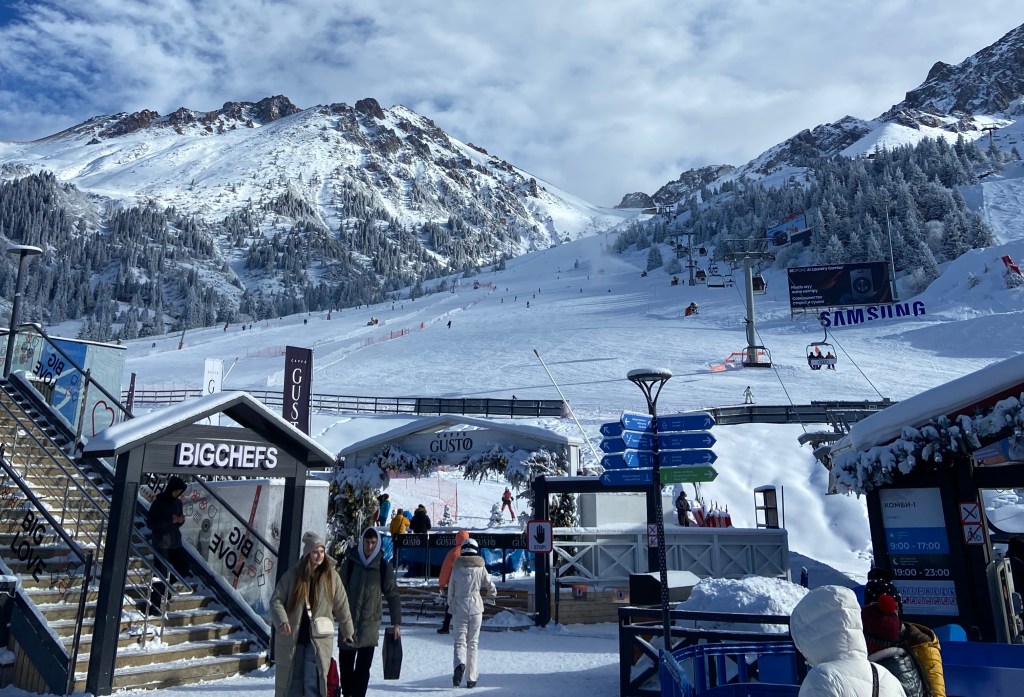
In the winter, Shymbulak Mountain Resort is a mid-sized, affordable ski mountain a short ride from downtown Almaty. In the summer, it offers hiking and surely other things—I cannot speak on this as I only visited during the winter months. If you are in Almaty during the winter months and feel like a day on the mountain, Shymbulak could not be more convenient. The resort itself is very modern, offering lifts and infrastructure identical to what you might find at a European resort. If you don’t ski but still happen to be in Almaty during the winter, Shymbulak is a great place to learn. If you don’t want to learn, there are several hikes accessible from the resort during the winter. The best of which is an Almaty can’t-miss and leads to a stunning glacial ice cave.
Getting to Shymbulak is easy. First, get on the No. 12 bus and stay there for about an hour. You will be swept through the city and, eventually, above its bustle and smog. The bus’ final stop is the Medeu ice rink, but you should get off one stop before at the gondola station. Get off the bus and walk across the street to the Gondola station. Buy a pass at the desk, get on the Gondola, and enjoy the scenic 20-minute ride up to the resort. Do be cautious of weather conditions before setting off, as the trail is steep and could be made difficult by low visibility or snowy weather.
If you want to ski, first buy a ski pass. There are beginner-specific passes if you plan on only using the beginner areas, but I wouldn’t recommend this. None of the terrain is particularly challenging, and I can promise that you will not be the only beginner on the main run. A ski pass will run you about thirty Euros, not unreasonable for a day of skiing—especially compared to prices in the U.S. You can rent skis from the base of the mountain, though I have not heard great things about the rental gear. I might recommend getting rentals in the city beforehand, but I do not know how difficult this process is.
If you don’t feel like doing much of anything, you are also free to spend the day at the base of the mountain. There are several restaurants all offering good food and a view of the mountain. There is a free tea promotion on weekends, and occasionally you can also snag free Redbull. If you like Eagles and allegedly traditional Kazakh dress, there is always a booth where you can pay to dress up in Kazakh clothes and take a picture with a live, large Eagle. The opportunities are endless.
Now, for the most important question—how is the skiing? The answer, unfortunately, depends. For a day or two after a decent amount of snow, the skiing is pretty good. The main run can get a bit choppy, but pretty much the entire mountain is skiable. The mountain is not huge, but there is still enough space for an intermediate powder day. If it has not snowed in a while, don’t expect much. The main run will remain open as there are many busy snow machines, but there will be few other options. The main run is long, but it does get boring after a while. It is almost always good in the morning but does tend to get icy in the afternoon. An average day at Shymbulak features a well-maintained main run and limited off-piste. It is a great place to learn to ski, a good place for intermediate skiers, and a place to ski for the advanced few. Regardless, it is worth a trip for all.
Green Bazaar
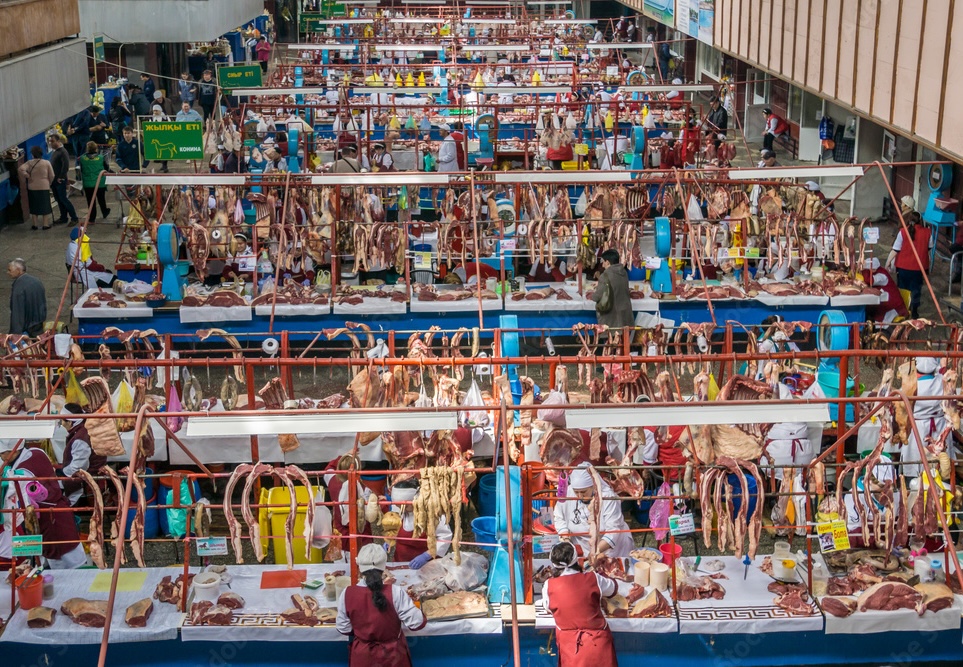
The Green Bazaar is a large, indoor market in central Almaty just a few blocks from the Ascension Cathedral. It has served as an important trading hub in Almaty since its creation in 1875. Today, visitors can stroll through the rows of fresh dairy products, meat, spices, preserved goods, and more. From pig heads to fermented everything, the bazaar has it all. If you are hungry, there are also multiple small restaurants within the Bazaar and many stalls offering bread and samsas. The central bazaar is the large hall depicted above, but the surrounding buildings are also bazaars—though these may be better places to shop for knock-off clothing than food.
If you are interested in sampling local food at the Green Bazar, it might be advisable to do some research beforehand. As an American, I found myself a bit overwhelmed by the quantity of food items I had never seen. Speaking Russian would also help. Haggling is expected, even for non-Russian or Kazakh speakers. The Bazar is open six days a week from 9 a.m. to 7 p.m. and is closed on Mondays.

A. Kasteyev State Museum of Arts
This is the best museum in Almaty and it isn’t close. With several large halls and exhibition spaces, it is easy to spend at least two hours here. Though not on the level of what you might find in some European Capitals, the museum is, in my opinion, the best art museum in Central Asia (and Bishkek has a nice one). There is a good selection of Kazakh art showing both traditional and Soviet styles. There is also a surprising amount of more contemporary works from sculpture to video and sensory art. I wouldn’t quite say this is a can’t miss, but if you are in Almaty for more than a day or two it is certainly worth checking out.
House Museums
Typing “museum” into Google (or Yandex) maps will yield dots across the city. Many of these results will be house museums. Common in Central Asia, these museums are converted apartments or houses of important historical figures. Almaty has many, but I only visited two: House Museum named after D. Konaev and the Museum of S. Mukanov. Both are located within a block of each other.
The D. Konaev Museum is a small building dedicated to the life and work of the Kazakh leader during many years of the country’s Soviet period. The exhibit celebrates his accomplishments and gives an overview of the country’s transition from an agrarian, nomadic society to an industrialized Soviet Republic.
I found the S. Mukanov Museum particularly interesting. A writer and national icon during the beginning of the Soviet period, the museum features an exhibit about the writer’s life and work as well as his well-preserved apartment. Again, it is a good window into early 20th-century Kazakh life. Born a nomad and later a leader of Soviet arts, Mukanov’s life story parallels the story of Kazakhstan itself. Everything in the museum is translated into English, and there are opportunities to read excerpts of the writer’s work. The apartment is also an interesting window into how prominent figures lived in the USSR.
Neither of these museums are must-sees, but both are worth some time if you are in the area. There are also many more in Almaty, and I am sure each deserves a quick stop.
Arasan Baths
If you have never experienced a Russian-style banya—or even if you have—Arasan Baths is a worthwhile stop in Almaty. Located downtown just blocks from the cathedral, it is accessible and the perfect end to a long day of sightseeing, skiing, or doing whatever else one might do in Almaty.
The building’s interior is large, impressive, and marble. On the way into the building, visitors can purchase felt banya hats and veniks (bundles of sticks visitors repeatedly hit themselves with to increase circulation). Both are recommended, though not required.
The price of a session varies from weekends to weekdays, but it is always affordable (under ten Euros for a two hours basic session). Once paid and through the gates, you have access to the building’s vast network of Russian banyas, Finnish dry saunas, and Turkish/ Moroccan Hammams. Men and women are split up, and your first stop is your respective gender’s locker room. There you will change and shower to prepare for the saunas.
Clothing is optional past the locker room. In my experience, about 25% of men wore swimming trunks and the rest opted for just a towel. You will not be judged either way—just go for what is most comfortable.
The process is fairly self-explanatory past the locker room. I won’t explain it all here. This link could be helpful if you want more information.
The entire experience is interesting, but it is impossible not to mention the building’s architecture. Perhaps the crown jewel is the domed pool room for cooling off post-sauna. It is entirely marble, with slabs lining the pool to lay down on and cool off. There are many similar marble rooms with slabs throughout the building, though most do not offer pools.
What to do in Almaty at night
101 Dump Gallery Wednesday Movie Night
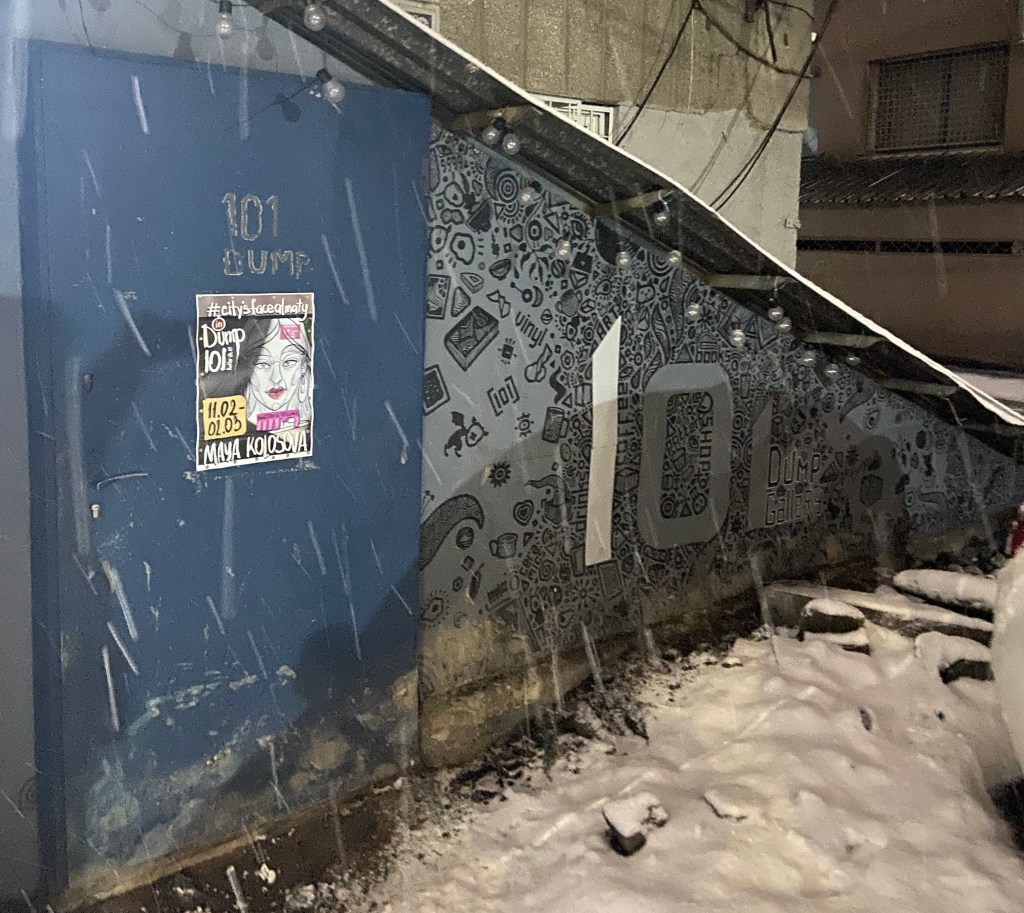
If you think the name sounds enticing, just wait until you have to try to find it. The 101 Dump Gallery is tucked away in a courtyard near central Almaty. Its entrance—depicted above—is an anonymous door wedged against a wall in an otherwise residential pocket. You walk into a dark stairwell, creep down the narrow, steep stairs, and suddenly find yourself in an amalgamation of a bar, gallery, and boutique shop. The front of the space is a bar with a small seating area. To the right, there is a hallway with various trinkets from local artists for sale ranging from Soviet pins to contemporary posters. In the back, the area opens up once again to a small gallery room showcasing work from local artists. The bar attracts a young, alternative crowd with a higher English-speaking ratio than you might find in the rest of the city. From the hidden entry to the mashup inside, it is a fascinating place.
Every Wednesday, 101 Dump shows a movie on a projector in the bar area of the room. They announce the movies beforehand on their Instagram, and many are English-speaker-friendly.
Bar Street
It is not that exciting, but it is something. This block of Furmanov Ave. between Kabanbay Batyr St. and Bogenbai Batyr St. is home to a strip of bars that can guarantee a good sample of Almaty nightlife. There are, however, a few things worth noting. First, none of these bars are particularly cheap. Expect to pay about what you would pay in Europe—between four and six Euros for a beer. Second, expect these places to fill up late. Things get going around 1 a.m., then they really get going around 3. Almatians eat dinner on an American schedule and go out on a Spanish one. Who knows what they do for the eight hours in between.
Where to eat in Almaty

Shashlik at Kirova Str.
Tucked away in an unassuming courtyard, Shashlik at Kirova Str. is perhaps the best place for tasty, affordable Central Asian food. With an expansive menu covering everything from shareable Kazakh Beshbarmak to Georgian Chakapuli, Shashlik at K. Str. has something to please everyone. The restaurant itself is nicely decorated and appears to have been recently redone. Tablecloths are interesting and in Central-Asian style, and nearly every table offers two cushy booths. The atmosphere is interesting, with women served beer with straws and music switching from Abba to Eminem and back to the Bee Gees. Everything on the menu is of a certain quality, but the kitchen shines with its lamb Shashlik. There are multiple types offered, but the plain “lamb” is the best. There is also a decent selection of salads and vegetable-first dishes for anyone whose Almaty trip has felt (fairly) lacking in greens. Most dishes range from 1,000 to 2,000 tenge (2-4 Euros), and it is possible to get a three-course meal with a handful of beers for under 15 Euros.
Speaking of beer, Shashlik at K. Str. sells 0.5-liter glasses for 600 tenge, or about 1.2 Euros. The beers are good (the Oceans 5 Belgian is the best) and go well with the sometimes oily food. This is probably my favorite restaurant in Almaty. The food isn’t the best in the city, but the quality-to-price ratio is top-notch. Note: type “Shashlik” into Google Maps and you can find a restaurant similar to this one nearly anywhere in the city.
Auyl
Located just below the mountains and just above the Medeu ice skating rink, Auyl offers a slice of Kazakhstan much different from what you will find in Almaty. Though accessible with just a quick, hour-ish ride on the No. 12 bus, the mountain hideaway feels miles removed from Almaty’s smog and bustle. Named one of the most beautiful restaurants in the world and recently featured on The World’s 50 Best Restaurants’ list, Auyl is an Almaty can’t-miss.
The restaurant itself offers an affordable selection of what it calls “neo-nomad cuisine.” Translated, they take traditional Kazakh dishes and offer a modern, well-plated spin. With a creative cocktail menu to compliment their kitchen’s experimentation, it seems difficult to go wrong at Ayul. Best of all, the whole experience is affordable as far as fineish dining goes. I ordered two dishes and a cocktail and it came out to just about twenty Euros.
Hole-in-the-wall samsas
This is less of a restaurant than it is an idea of a restaurant. The term hole-in-the-wall is overused. I regret that I am using it here, but I cannot come up with a better way to describe what is literally a hole in a wall. Throughout Almaty and in at least one spot in Bishkek, small Samsa shops operate through small windows in what would otherwise be called a wall. It is easiest to imagine a ticket counter that sells baked goods. You can’t search for these places on map apps, but they always appear when you feel like a snack. They are also good motivation to keep your eyes up and stay aware of your surroundings. Samsas are available at nearly every grocery store or mini-market, but the ones purchased through a window in a wall are always the best.

What to eat/ drink in Almaty
Shasklik – meat on skewers
Kurt – small, very salty preserved cheese balls
Kumis – a fermented horse milk drink
Tandyr nan – round, intricately designed bread
Samsa – layered, flakey bread with various savory fillings
Plov – Central Asian rice (pilaf) dish
Kazakh Chocolate – Delicious chocolate available in supermarket identifiable by packaging featuring Kazakh flag
Manti – Central Asian dumplings
Lagman – Central Asian hearty noodle dish
How to get around Almaty
The most important thing to know about getting around Almaty is that Google Maps’ utility is limited. Locals use an app called 2Gis, but I could not download it due to some regional restriction (I think). Instead, I use Yandex Maps, which seems to be Russia’s answer to Google Maps. The interface is in English and it is very easy to use. Yandex Maps is where I find all my navigational information.
Busses
Busses in Almaty are easy. Like Google Maps, you can open Yandex Maps and type in where you want to go. The app will create a route for you and show you what bus lines you can take. If you are familiar with Google Maps, Yandex will be easy. Like in any city, the bus arrives and you get on it. Busses can be unusually warm especially when crowded, but for the most part, they are clean and modern—some even offer USB charging ports.
One clue about the buses: don’t pay. I made it a month in Almaty without paying for a bus. Occasionally someone will come on board to check your payment. In this case, I found looking confused and speaking in English was an easy way to get dismissed. The one time this didn’t work I was directed to the front of the bus where I paid 500 tenge (about 1 Euro) for a ticket.
Metro
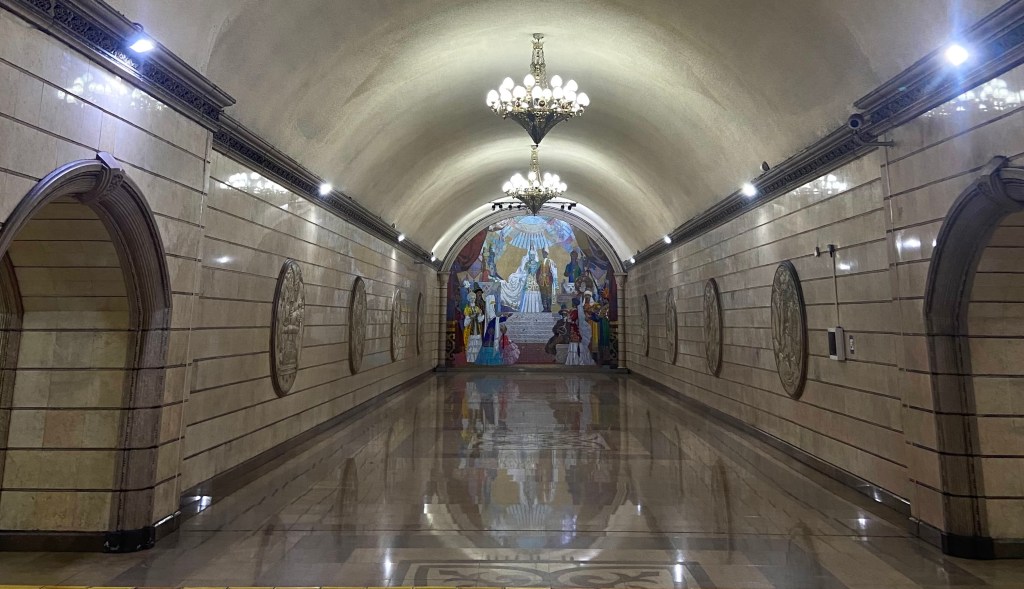
Almaty’s metro is not nearly as well connected as its bus system, but it is worth the ride. The one underground line passes through the center of the city and could be of some convenience during heavy traffic (often). Regardless of if you need it, a metro trip is worth your time.
Chandeliers provide light as passengers wait for their train on either side of the central hall, enjoying the pleasant and surprisingly user-friendly underground experience. All signs and in-train communications are in Russian and English, and there are many safety officers keeping the peace at each station.
Taxis
Like many cities, Almaty is full of aggressive taxi drivers eager for your business. Don’t give it to them. Instead, use the local Uber alternative—Yandex Go. These quasi taxis are dirt cheap (think 4 Euros for an hour’s drive) and very convenient (less than 10 minute wait at any hour). The cars are clean, and though the drivers often speak no English they are friendly and helpful. Yandex Go can also be used to book longer drives, though it may not always be your cheapest option. I would suggest using it for trips within or close to the city. Yandex Go also operates in many other Central-Asian and formerly Soveit countries.
Longer Trips
You can take both busses and trains for longer trips out of Almaty. The bus station is helpful for the former, and the train station for the latter. I have only taken one bus out of Almaty, but the process was easy. I showed up at the bus station in the late morning, walked to the ticket counter with Google Translate ready, and asked how to get to Bishkek. An hour later, I was on a bus.
For a more detailed guide to the bus trip from Almaty to Bishkek, see the in-depth guide here.
The bus station also offers ATMs, a restaurant, and several snack counters for longer waits. If you are planning a bus trip, be prepared to set aside some time for a long trip to the bus station as it is a little far from the city center.
How to pay in Almaty
Payment in Almaty is mostly easy. There are international ATMs throughout the city for easy access to Kazakh Tenge, but credit cards and Apple Pay are accepted almost everywhere they would be in a country like the United States—meaning you may be out of luck at some smaller vendors or markets. Still, cash is not difficult to come by.
You will see Kazakh people often paying with QR codes. Unless you have a Kazakh bank account, it is best to ignore this. There is always an alternative.
For city buses, you have two options. Either you can download the local Kaspi app and add money to your account, or you can pay the bus driver with cash. See Getting Around for more information.
 Wide Open Road