Category: Central Asia

  • A Horse Tour in Kyrgyzstan

    A Horse Tour in Kyrgyzstan

    We knew it might rain. The forecast predicted rain on the first two days of the trip and clear up on the third. We had notice and time to prepare. Still, when we woke up to grey skies and the sound of rain pounding against the windows, we were disappointed. Worse, the reality of what we were setting ourselves up for set in—three days on horseback in the rain. 

    I had come prepared with a raincoat and a poncho to wrap my legs in. I planned to wear three pairs of pants but cut the number down to two when I tried to walk. I had a raincoat for my backpack, ski gloves, and a balaclava. I opted for all but the balaclava as we stepped into the cold and mud to walk from one guesthouse to another. 

    Our guide, Timur, met us outside and showed us to his living room. Inside the room on the floor sat the seven other members of our group, drinking tea and enjoying the warmth before heading out into the rain. We joined, contorting ourselves into criss-cross-apple-sauce to fit at the low table. Our hosts brought us soup and an endless supply of tea. They told us we would wait for it to stop raining. Judging by the endlessly grey skies and weather forecast, it seemed like we would be sitting for days. 

    Sure enough, about two hours after our arrival, we got up and went outside to meet our horses. Mine, dark brown with a black tail, bore a Kyrgyz name meaning colorful. Our guides instructed us to say “che” and kick the horse to go. To stop, we could say “brrrr” with a rolled r and pull back on the reins to stop. We should only mount and dismount from the horse’s left side and not ride directly behind the horse in front of us. The mud caked the bottom of my shoes and the skies looked ever-ominous, but it was not raining. We took off behind Timur, our group of fourteen moving slowly through the village’s dirt roads. 

    When we reached the outskirts of the village, we began to climb into the nearby mountains. The videos I watched of Kyrgyzstan before the trip showed expansive green grasses and wildflowers with snowy peaks only far in the distance. Mid-April offered a different landscape. The grasses were beginning to turn green, but patchy snow was still visible in every direction. We were already high—about 8,000 ft—and would only get higher. We rode mostly through valleys the first day, but the view to all sides featured stark, steep mountains.

    We followed a stream for much of the way. At one point hundreds of ravens crowded the skies and trees along the river, their cries darkening the otherwise tranquil atmosphere. We asked our guides what they were doing there. Apparently, it was the only place in the valley with trees.

    There did not appear to be much life of any kind in the valleys. There were some wild grasses, but nothing higher than my knees. At this altitude, there were few trees or shrubbery. Instead, yaks, cows, and horses roamed the hills. Horses are visible throughout the wilds of Kyrgyzstan, but there is not a single wild horse in the country. Only the male horses are ridden. The females, meanwhile, are left to roam the hills until their time to produce babies comes along. Still, they roam in groups through the hills seeming to believe they are free.

    We were scheduled to spend the first night at a hut halfway up the mountain and the second in yurts by Son Kul Lake just over the pass. We would ride for about six hours each day. Three hours into the ride, we stopped by a stream and dismounted. The ride had gone smoothly but my legs nearly crumpled when they hit the ground. When I could walk normally again, I was back on the horse with another three hours in front of me. My left knee had thoroughly cramped and my butt bruised when we stopped for the second time at our hut. 

    We piled inside and were quickly served dinner—more soup, this time with yak meat, and tea. In Kyrgyzstan, I learned, people don’t drink water. They drink fermented horse milk and tea instead. Dinner led to cards and vodka and eventually bed. I chose to sleep in the yurt along with the five German members of our troupe.

    The yurts are interesting. In Kyrgyzstan, the insides are adorned with beautifully unique felt carpets with swirling patterns and bright colors. These carpets line the walls and floor for warmth, and a wooden collapsible skeleton provides structure. In the center of the yurt on the ceiling, the wood support beams converge in a cross shape symbolizing the country. The same shape is visible on the flag and throughout the country.

    Though beautiful, our yurt was a little too cozy. It felt like a sauna when I first walked inside. I mean that almost literally. It was far hotter than any bedroom I have ever slept in. A still-crackling fire in the front of the yurt kept the heat going into the night.

    We got back on our horses at nine the next morning after a breakfast of eggs and bread. We were engulfed in snow about an hour into the ride. It was very dry and icy and not coming down hard. Still, everything was white. Eventually, the snow stopped but did not go away. The horses slowed down, and instead of mud wet snow flew up from under their hooves. My horse particularly liked the snow. I began to count. Every thirty seconds, without fail, he would yank on the reins, bend forward, and start eating snow. I quickly fell to the back of the line. 

    We reached the 3,400-meter pass after about three hours. An hour later, we crawled off our horses in front of our camp and a snowy expanse—the lake. The camp consisted of two sleeping yurts with six beds packed against one another. The communal yurt featured a small kitchen and a long, L-shaped table. We were served plov with bread and tea shortly after our arrival. I appreciated the break from the soup and the chance to sample Kyrgyz plov—after eating the dish in Kazakhstan, Uzbekistan, and Tajikistan, I was curious to see how the Kyrgyz varietal stacked up. 

    For dinner that night, we ate more soup, played more cards, and finished our vodka. I succeeded at a Dutch word search and gawked at a Dutch crossword before it was again time for bed. The second night was warmer than the first. Eventually, however, I again drifted to sleep for our final and longest day. 

    The next morning followed the routine of the one prior. We woke up, ate eggs and buckwheat, and got back on our horses. While we were waiting to trot back down the mountain, one of the guides’ horses broke free and took off in a gallop over a hill. We watched the horse dip below the horizon with two bags full of our backpacks bouncing against its legs. A guide took off on his horse in pursuit. When neither returned after thirty minutes, we left without them. 

    My horse behaved better during our descent. The ride took about seven hours, but the terrain was familiar. We stopped at the bottom of the mountain for our horses to rest, then jumped back on for the last hour of riding back into the village. 

    If we had visited in the summer, we would likely have booked a six or seven-day tour. Because it was still spring, those tours were not running. We were lucky. Three days of horseback riding had been a fun experience, though a little uncomfortable. After seven days, however, I am not sure I would be able to walk or sit down. 

    We ate lunch in the village, boarded our pre-ordered taxis, and checked into our Bishkek hostel that night. I ate dinner the next night in Kazakhstan and enjoyed horse in a different form—a backhanded way to make up for the butt bruise.
  • An Early Morning in Kyrgyzstan

    An Early Morning in Kyrgyzstan

    The door to our room swung open at 9 p.m. 

    “Dinner will be delayed. We were out hunting with illegal guns and we had some trouble with the ecological police. Our owner was arrested, sorry. No more than forty minutes wait.”

    The door shut and we sat for a second. We moved inside the dining room to play cards. The room was dark save for a few emergency lights powered by a car battery in the corner. We lit a candle, set it in the middle of the table, and dealt a hand. For the next hour we waited in the candlelight deliberating on a decision made hours before. 

    Eventually, we were served a plate of noodles with meat. An English-speaking guide, Ermek, sat down at our table. We had planned to hike back down to the city that afternoon, but he had invited us that morning on a hike the following day. He wanted to be the first to summit a high mountain lake that season. He had tried to reach the lake two weeks prior but was stopped in his tracks by snow up to his torso. He planned to attempt the journey the next morning. We intended to join. 

    His plan was to “open” the hike by setting up rope stations along the hike’s steeper segments. Last season, he told us that he opened the hike at the end of April. A French couple had joined him then. The snow was up to their chest, he said, and they got back after dark. They set out at five in the morning. 

    We asked more questions as we ate. He was drunk and more passionate that we join him than you would expect someone offering to do his job for free would be. All he wanted of us, he said, was to film a video talking about how much we loved Kyrgyzstan and giving “true feedback” about the hike. 

    He warned that the hike would be difficult. Promising twelve miles round trip and 5,000 feet in elevation gain, I believed him. We were concerned about our gear. I had a pair of semi-waterproof hiking shoes and no waterproof pants. I would carry an extra pair of socks in my backpack. Jonas had a pair of tennis shoes and jeans. Ermek cast our doubts aside by showing us his mesh Adidas tennis shoes. He said he had forgotten his hiking boots. It didn’t help. 

    He wanted to leave early in the morning because the snow conditions would be better. The snow would grow wetter as the day went on, so if we started our trek while the snow was still frozen over, we might manage to walk on top of the frozen layer without sinking in. There was no telling what would happen on the walk back down.

    We finished eating and confirmed that we would join. It was past midnight by the time we finished eating. My alarm went off at 4:30 in the morning. We rolled out of bed, ate a breakfast of eggs and hot dogs, and set off in the dark.

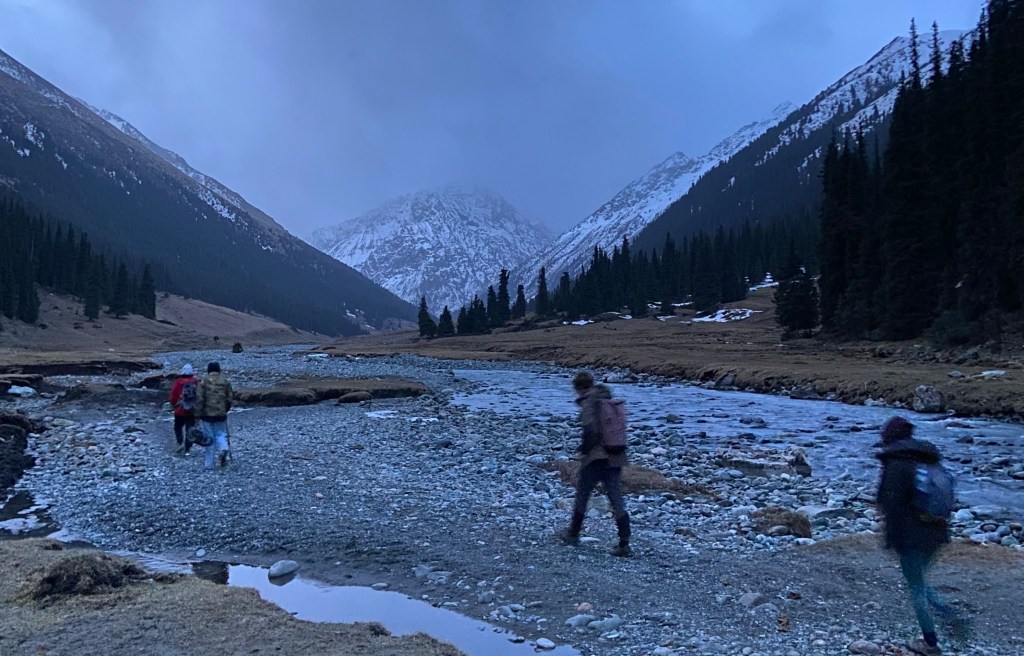
    We walked the first hour through mud with just phone flashlights and the full moon. We turned our flashlights off as the second hour grew gradually brighter and the valley opened up. We followed a river to a bridge. We crossed the bridge, and so began the third hour and with it our climb. 

    We hit snow twenty minutes after we began to climb. The top layer was not frozen over. Each step pushed frozen crystals into the crack between my sock and the edge of my shoe. We continued for another half hour. Occasionally we reached an island of land where I could stop, remove my shoe, and shake out the snow inside. At some point, our guide stopped us and asked us to wait in a clearing while he went on. We watched as he walked with his snowshoes across a snowy pass, sinking further with each step until we could no longer see his waist. He stopped, looked around, and walked back. 

    There was too much snow. Worse, the conditions were prime for an avalanche. A wall of grey clouds in the distance reassured us of our decision as we turned back through the snowfields. We felt the first drops when we reached the bottom of the hill. 

    The rain continued as we made our way back to the hut. It never crescendoed past a drizzle, but it was enough to wet my clothes. I hung them up to dry and headed inside for tea. Once again, we deliberated. It was still well before noon. With reaching the lake out of the question, it made sense to walk the ten miles downhill to Karakol. The rain had stopped, but the clouds were still grey. We had two options: leave and risk getting stuck in the rain, or sit around and inevitably get stuck at the hut yet out of the rain. We decided on the former, packed our things, and set out on the second hike of the day. 

    The rain came three miles into our descent. It was not yet heavy, but it was enough to require raincoats. As I finished tightening mine, a tan, Jeep-looking vehicle from the Cold War approached us from behind and came to a stop. “Karakol?” its driver asked. It was raining and we had been up since four-thirty. We said yes and climbed in, four squeezed in the back and one in the front. The driver asked for five dollars from each of us.

    The Jeep should have been retired with the Berlin Wall. Three wires ran from the dashboard up the windshield to where the rear-view mirror once had been. The dashboard featured four dials, two silver switches, six unmarked red and black buttons, and one red button in the middle. The ceiling was exposed insulation. The windows could go neither up nor down, and the whole thing smelt of gas. 

    We passed the same group of hikers three times on the way down the mountain. There wasn’t really a road. With no maintenance to speak of and constant rocks and dips, our seven-mile ride took over an hour. The laughs at our jeep’s state during the beginning of the ride quickly faded as fatigue and body heat consumed us. Each bump sent elbows flying through the back seat, and every lurch nearly folded the bench seat in upon itself.

    An hour and a half later, we rolled out of the little tan jeep in front of our hotel. We rolled out of the car, stretched our legs, and checked in. It was not even one.

    Our ride
  • Uzbekistan, or a Lack Thereof

    Uzbekistan, or a Lack Thereof

    I drifted out of sleep as the sun began to rise. I peeked through the bus curtains at highway and steppe. The landscape resembled that around Almaty, where we had departed from fourteen hours earlier. Google Maps situated us just miles from the Kazakhstan / Uzbekistan border as the bus rolled to a stop and the driver got out to smoke a cigarette. He got back in a few minutes later and the bus growled to a start. We kept on, circling Tashkent on the Kazakh side of the border. 

    Some miles later, the circling stopped. We were on the highway, going straight. Jonas and I looked at each other. The cigarette break was our stop, and now we were flying down the highway in the wrong direction. With each passing second civilization crept further back in the rearview. When the driver took his next cigarette break, we hurried to the front of the bus, put our shoes back on, and asked for our bags. He opened the storage compartments and, gruffly, gave us the name of the border crossing, and instructed us not to spend more than 2,000 tenge getting there. 

    The bus left us standing on the side of the road. We waited to cross as a man on a wagon pulled by a donkey meandered by. It was a warm morning. I pulled out a pastry I had packed as Jonas tried to find a taxi on his phone. He waited five minutes. No takers. I tried mine and we both waited another ten. Nothing. The border was a ten-mile walk away. We stuck out our thumbs. 

    Soon after, a car pulled off and we got in. There was another Kazakh man in the front seat. We told him our destination and he took off in the right direction. A few minutes later, the car pulled over again. Jonas scooted into the middle seat, we picked up another passenger, and we kept going. A little while after that, both passengers took to the curb. They handed our driver some change on the way out. Our next stop was the border. We made it, and I handed our driver what little tenge I had left—2,000. After a bumpy morning, there we were: the Kazakh / Uzbek border. 

    We walked down a long street lined with people. They didn’t seem to be coming or going, just standing. Many were taxi drivers. We walked by without acknowledgment. We made it to the Kazakh side, showed our passports, scanned our bags, and passed through. From there, we entered no man’s land. We crossed a river lined on each side by multiple layers of barbed-wire fences and walked through the large gates challenging us to enter Uzbekistan. Jonas took his spot in line and I stepped in behind him. He got to the window, handed over his passport, got a stamp, and walked through. I handed over my passport and situated myself in front of the camera waiting to add a stamp to my collection. It didn’t come. Instead, the border officer asked “Visa?”

    I stared blankly after him. My usual “niet Ruski, tourist. Angliski” wouldn’t work here. I think I asked if Americans need visas. Then I Googled it. The answer: yes. Shit. I had double-checked Tajikistan and Kyrgyzstan but somehow forgot our first stop. He took me aside where we met with four other Uzbek border officers. One spoke English. He confirmed my need for a visa and informed me that I could apply online. I opened the application. No, he explained. It takes three days. I told him that I would go back to Kazakhstan and apply. I crossed back over the river, handed my passport back to the Kazakh officer, and was stamped back into Kazakhstan. 

    Twenty minutes later, I was one of the people loitering outside of the gates. I now had three days to kill. I imagined myself shacking up at a local hotel, burning through Netflix’s library, and maybe finishing my book. I had just come fourteen hours from Almaty. Returning was not an option. Worse, I had no cash. With no other obvious choice, I walked into the nearest—and only—hotel and asked how much a night would cost. I was told sixty dollars and walked back out. I spent the next hour walking around with backpacks on my chest and back in search of either a hotel or an ATM. None of either. I found a seat in the shade. 

    I had planned for the data on my esim to run out just as I crossed the border, so I first had to hope I would have enough to load the refill website. I did. Next, I opened Google Maps and typed in “hotel.” Nothing. I zoomed out—still nothing. I zoomed out again and saw “Shymkent” written a little ways back in the opposite direction. Shymkent had hotels. Better yet, it had hostels. Unfortunately, Shymkent was two hours away.

    A Google search revealed that the only way to Shymkent from the border was via shared taxi. With no cash and no ATM, that was not an option. I rummaged through my backpack for my other wallet and coin purse. I found one hundred New Zealand dollars, some Kyrgyz Som, some Kazakh and Australian coins, and a five Euro note. There were no ATMs in sight, but nearly every shop window was illuminated with foreign exchange rates. I tried the first window I found. I slid my five euros under the glass. The teller looked at it and slid it back, shaking her head. I tried three more windows with the same result. I tried the New Zealand money at another—no luck. I crossed the street to try again. I found a small window and handed an older woman my humble five-euro note. She typed into her calculator and showed me the result: 2,500 tenge. I nodded “harasho” and she handed me the Tenge. 

    I turned back across the street to a woman standing in front of a bus and yelling at me. “Almaty?” she asked. I had no interest in another 14-hour bus ride. “Niet. Shymkent.” She turned to a man by her side and they talked for a moment. “Shymkent, da,” she said. I approached and the man came to take my bag. “Etta, v Shymkent?” I asked. She nodded her head. My Russian was spent. “How much?” I asked, pinching my fingers together in the universal money sign. I pulled out my wallet to reinforce the gesture. She responded in Russian and I showed her my 2,500 tenge, hoping it would be enough. She took it and gestured for me to take a seat. 

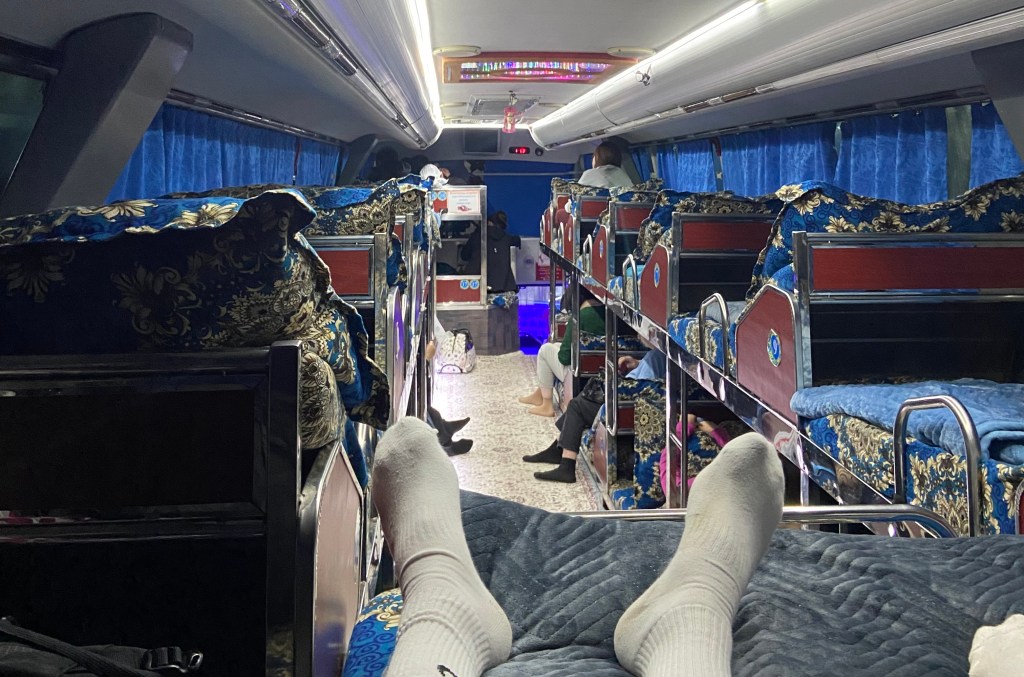
    It was a sleeper bus. I climbed onto a top bunk and closed the curtain over the window. It was at least 80 degrees inside. We soon started moving and I started my Uzbek visa application. We broke down for about two hours along the way but I had stopped paying attention to time long before. Eventually, the bus—with a new wheel—pulled over. A man got up in the front, looked in my direction, and yelled something. I looked at Google Maps, figured it was the closest we would get to Shymkent, and got off the bus. It pulled away and left me at a strip mall outside the city. This time, my taxi app worked. 

    It has been five days since I was rejected from Uzbekistan. My 30 days in Kazakhstan lapsed two days ago, but I am still here—an outlaw. My visa did not arrive in three business days as it suggested on Uzbekistan’s website. It might come on Monday, or it might not. Either way, by the end of my stay, I will be an expert in Shymkent’s coffee scene. I’ve taught an English class, spent an evening beating a Kazakh English speaker in ping pong, and lost to another in chess. When I finish writing this, I will walk to a nearby mosque, look at it, and get dinner. Tomorrow, I plan to wake up, see my visa in my inbox, shower, and figure out a way to Tashkent. Or, maybe I’ll find another seat at another coffee shop. At this point, any day that doesn’t end in deportation is a good one.