
What is Samarkand?
Samarkand, the third-largest city in Uzbekistan, is undoubtably the country’s historical capital. It is one of the oldest continuously inhabited cities in the world with evidence of human settlement dating back to the Paleolithic period. During the height of the Silk Road, Samarkand was one of the largest and most important cities in Central Asia. Evidence of this importance is today relevant in some of the country’s most beautiful architecture in the form of old mausoleums and mosques. It is divided into the old, historical city and new more soviet area, but I recommend sticking to the old city. It has a very different feel from Tashkent and other non-Uzbek Central Asian cities. The architecture is difficult to describe, but it is beautiful and unlike anything you will find in other countries. Though fascinating, Samarkand is not a huge city. Three or four days is plenty of time to take in its sights, food, and atmosphere. Samarkand is easily reachable from Tashkent by bus, train, or shared taxi. Check out my guide for traveling from Tashkent to Samarkand by bus here.
I would recommend visiting Samarkand as soon as possible. Uzbekistan is rapidly popping up on the radars of travelers in the U.S.A. and Europe, and it will not be long before the small city is overrun by travelers looking to experience its uniqueness. There are already more tourists in Samarkand than I have seen anywhere else in Central Asia, and I would urge seeing the city before over-tourism takes hold.
What to do in Samarkand

Shah-i-Zinda
This city of 11th-14th century mausoleums is Samarkand’s most impressive attraction. After passing through the main gates—impressive enough already—you enter a vast hallway lined on each side with elaborately decorated tombs. Each has its own breathtaking design both inside and out. Entry is affordable and absolutely worth it. It is one of the most beautiful sites I have ever seen and a great example of Uzbekistan’s signature blue mosaics. Though it is not a huge area, I would recommend setting aside one to three hours to take in the whole site.

Registan Square
Probably the most striking landmark in Samarkand, Registan Square is a large, beautful public square flanked by three madrasahs (education buildings built between the 15th and 17th century. The square is worth a stop, and for a few extra euros visitors can walk around the square (the alternative being standing behind a barrier at the edge). Though beautiful during the day, the square and surrounding buildings are equally as stunning in the evening. They are illuminated nightly with different colors, and though their blues might be lost in the dark, they take on a life of their own when the sun sets. I would recommend visiting at both times of day. It does not take long to see and is one of the most beautiful sites I have ever visited.

Amir Temur Mausoleum Gur-i Amir Сomplex
The Amir Temur Mausoleum is another Samarkand can’t-miss. Located about a ten-minute walk from Registan Square, this Mausoleum looks modest enough from the street. The entryway leads into a nice courtyard flanked by mosaiced buildings with the main, turquoise-domed hall in the center. Admission costs about five euros, but it is well worth it. The inside of the 14th-century dome is breathtaking. The mausoleum is probably the most impressive interior in Samarkand—and maybe Uzbekistan. Built for the grandson of an Uzbek sultan in 1403, the mausoleum now houses several tombs, including that of the Sultan.
The mausoleum is reported to also be partially responsible for the Nazi invasion of the Soviet Union. Apparently, Soviet scientists once took an interest in the burial site and planned to open it. Written on the tomb are the words “when I rise from the dead, the world shall tremble.” The people of Samarkand alerted the Russians to the warning, but they did not listen. The tomb was opened, and two days later the Nazis invaded the Soviet Union. Stalin was deeply disturbed by the news of the curse. He ordered the tomb to be restored in December 1942, and a month later the Soviet Union was victorious at Stalingrad.

Siab Bazaar
Very different from Tashkent’s grand domed bazaar, Siab Bazaar is open-air and spread out. It offers picked food, meat, and spices available at most bazaars across Central Asia, but it also features a wide and beautiful selection of pottery. Better yet, the beautiful and allegedly hand-painted plates, bowls, glasses, and figurines come at a very affordable price compared to what you might pay for something similar in the U.S.A. Many Central Asian bazaars blend together, but this one has a different feel. It is absolutely worth a stop, and maybe leave some extra room in your backpack or suitcase to bring home some beautiful pottery.
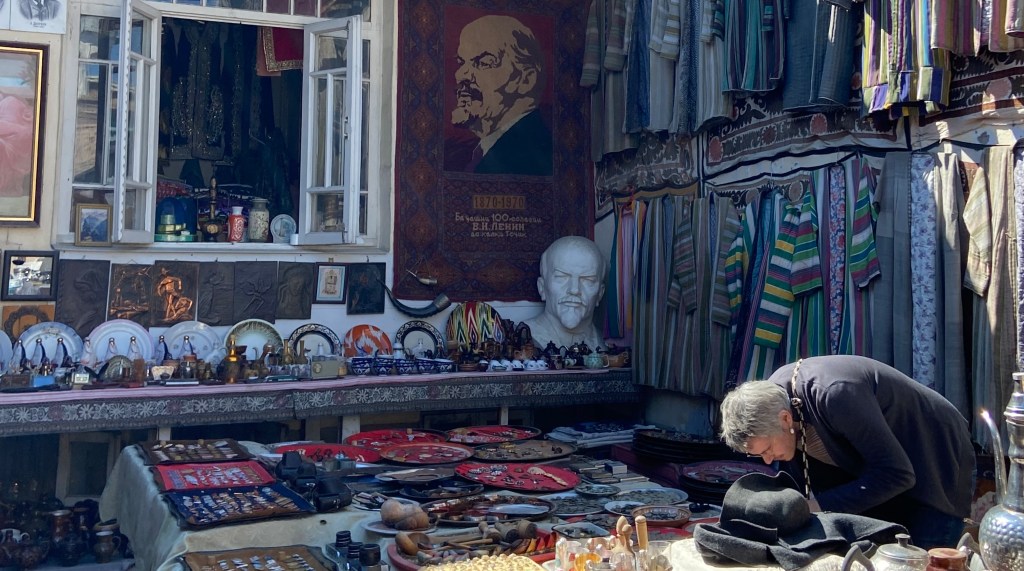
Haydar’s Antique Shop & Flea Market
Tucked away in a courtyard of one of Samarkand’s maze-like streets (Google Maps), this antique shop is worth a stop. As far as I could tell, it is the only one in Samarkand—and probably one of few in Uzbekistan. It is your one-stop shop for all things antique. There is a big selection of Soviet-era goods ranging from money to cigarette cases and busts, but there is also a lot of purely Uzbek memorabilia. If you want a souvenir but prefer to steer clear of souvenir shops, this is the place for you.

Ancient City and Afrasiyab Museum
I would not call it a must see, but if you have some time and feel like getting out of the city, the remains of the old city is worth a trip. Located in a huge, seemingly vacant field near the center of the city, the ancient city was inhabited beginning in 500 A.D. leading up to the Mongol invasion. Today, there is not a lot to see. It is essentially an open-air archeological dig. There are large holes and caverns in the ground presumably dug in search of artifacts and visitors are free to explore as they wish. There is old pottery littered about the area, and if you are lucky you may find one still displaying an intricate pattern.
At the boarder of the site is the Afrasiyab Museum. Though not huge, it is worth a quick trip following an exploration of the site. It features artifacts from the ancient city, notably including a large wall mural discovered as part of an archeological dig. If you are interested in Samarkand’s ancient history, this is a worthwhile stop.
Where to eat in Samarkand

Resturaunt Karimbek
Serving refined Uzbek food at a reasonable price, Karimbek should be on everyone’s Samarkand to-eat list. The food is good, the prices are reasonable, and the atmosphere is classy without being too fancy. The food is similar to what you will find on menus throughout the city—plov, shashlik, etc.—but the quality is very good. Alcohol is also served at very reasonable prices. A trip to Karimbek is not complete without sampling the appatizer they call “mulatto.” Essentially, the dish is black bread dipped in an aoli and coated in shredded gouda. It sounds strange, but it is delicious. The “fried Lagman” is also the best lagman I have had in two months traveling Central Asia.

Samarqand Osh Markazi N1
No trip to Uzbekistan is complete without lots and lots of Plov. With each region comes a new style of plov to discover. When in Shymkent, then, one must sample Shymkent plov. Where better to do so than the city’s best, no-frills plov restaurant. The process of ordering at Samarqand Osh Markazi N1 could not have been easier. I walked in, sat down, and within minutes I was presented with a platter of salads. I choose the kefir cucumber soup. I was then asked if I wanted a full or half portion of plov and if I would like tea and bread. I responded full and yes and yes. I was served a delicious plate of Samarkand plov as soon as I finished my soup. Plov is delicious no matter where you get it, but this was some of the best I have had in Uzbekistan. Even better, the bill came to about four euros for plov, tea, salad, and bread. If I am ever back in Samarkand this will be my first meal, and I recommend that it be yours as well.
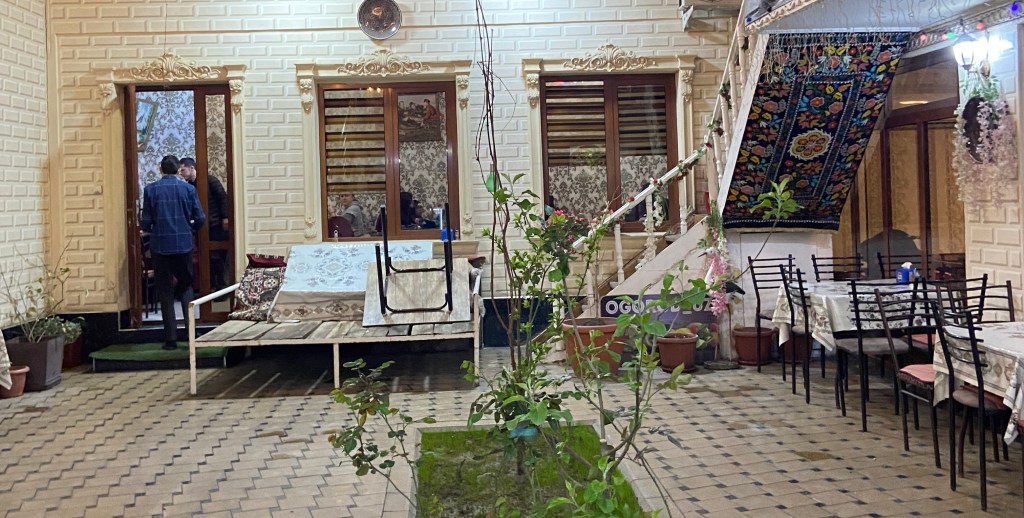
Shokhrukh Nur
Centrally located within minutes of Registan Square, Shokhrukh Nur is a great stop for traditional Uzbek food. Its menu includes a range of soup, manti, and other typical foods, but the highlight is the Shashlik. I recommend the ground beef and lamb gun (whatever that means), but it is all good. Prices are cheap (full meal for under five euros) and beer goes for about one euro. It is similar to the kind of place you’ll find all over Samarkand, but in my limited experience Shokhrukh Nur is home to Samarkand’s best Shashlik.
What to eat in Samarkand
Shasklik – meat on skewers
Kurt – small, very salty preserved cheese balls
Tandyr nan – round, intricately designed bread
Samsa – layered, flakey bread with various savory fillings
Plov – Uzbek rice (pilaf) dish with meat
Manti – Uzbek beef dumplings
Lagman – Hearty Uzbek noodle dish
 Wide Open Road