
We knew it might rain. The forecast predicted rain on the first two days of the trip and clear up on the third. We had notice and time to prepare. Still, when we woke up to grey skies and the sound of rain pounding against the windows, we were disappointed. Worse, the reality of what we were setting ourselves up for set in—three days on horseback in the rain.
I had come prepared with a raincoat and a poncho to wrap my legs in. I planned to wear three pairs of pants but cut the number down to two when I tried to walk. I had a raincoat for my backpack, ski gloves, and a balaclava. I opted for all but the balaclava as we stepped into the cold and mud to walk from one guesthouse to another.
Our guide, Timur, met us outside and showed us to his living room. Inside the room on the floor sat the seven other members of our group, drinking tea and enjoying the warmth before heading out into the rain. We joined, contorting ourselves into criss-cross-apple-sauce to fit at the low table. Our hosts brought us soup and an endless supply of tea. They told us we would wait for it to stop raining. Judging by the endlessly grey skies and weather forecast, it seemed like we would be sitting for days.
Sure enough, about two hours after our arrival, we got up and went outside to meet our horses. Mine, dark brown with a black tail, bore a Kyrgyz name meaning colorful. Our guides instructed us to say “che” and kick the horse to go. To stop, we could say “brrrr” with a rolled r and pull back on the reins to stop. We should only mount and dismount from the horse’s left side and not ride directly behind the horse in front of us. The mud caked the bottom of my shoes and the skies looked ever-ominous, but it was not raining. We took off behind Timur, our group of fourteen moving slowly through the village’s dirt roads.
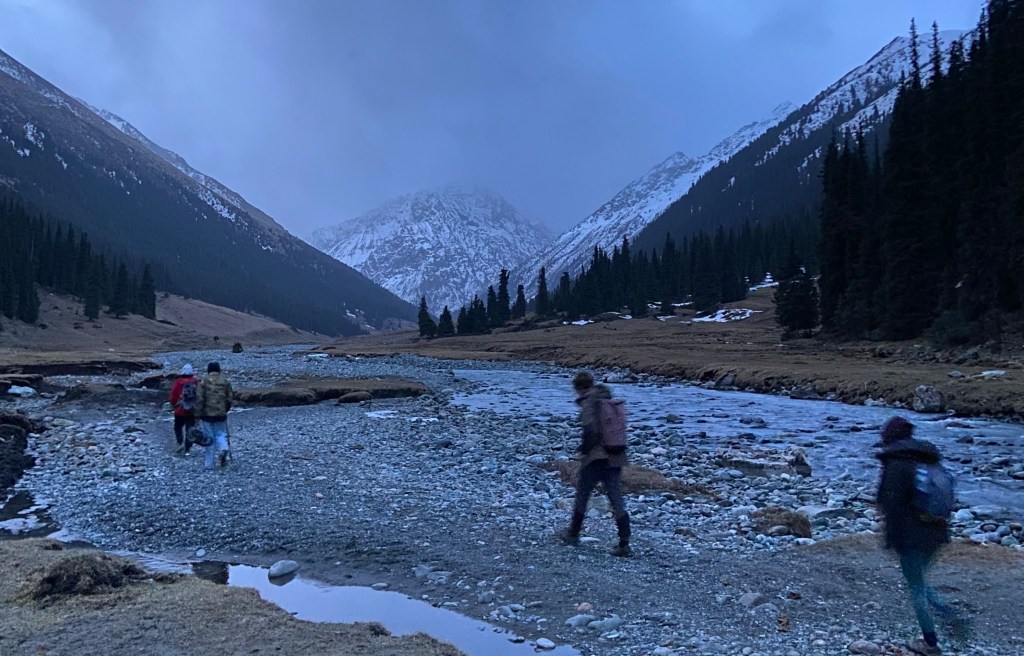
When we reached the outskirts of the village, we began to climb into the nearby mountains. The videos I watched of Kyrgyzstan before the trip showed expansive green grasses and wildflowers with snowy peaks only far in the distance. Mid-April offered a different landscape. The grasses were beginning to turn green, but patchy snow was still visible in every direction. We were already high—about 8,000 ft—and would only get higher. We rode mostly through valleys the first day, but the view to all sides featured stark, steep mountains.
We followed a stream for much of the way. At one point hundreds of ravens crowded the skies and trees along the river, their cries darkening the otherwise tranquil atmosphere. We asked our guides what they were doing there. Apparently, it was the only place in the valley with trees.
There did not appear to be much life of any kind in the valleys. There were some wild grasses, but nothing higher than my knees. At this altitude, there were few trees or shrubbery. Instead, yaks, cows, and horses roamed the hills. Horses are visible throughout the wilds of Kyrgyzstan, but there is not a single wild horse in the country. Only the male horses are ridden. The females, meanwhile, are left to roam the hills until their time to produce babies comes along. Still, they roam in groups through the hills seeming to believe they are free.

We were scheduled to spend the first night at a hut halfway up the mountain and the second in yurts by Son Kul Lake just over the pass. We would ride for about six hours each day. Three hours into the ride, we stopped by a stream and dismounted. The ride had gone smoothly but my legs nearly crumpled when they hit the ground. When I could walk normally again, I was back on the horse with another three hours in front of me. My left knee had thoroughly cramped and my butt bruised when we stopped for the second time at our hut.
We piled inside and were quickly served dinner—more soup, this time with yak meat, and tea. In Kyrgyzstan, I learned, people don’t drink water. They drink fermented horse milk and tea instead. Dinner led to cards and vodka and eventually bed. I chose to sleep in the yurt along with the five German members of our troupe.
The yurts are interesting. In Kyrgyzstan, the insides are adorned with beautifully unique felt carpets with swirling patterns and bright colors. These carpets line the walls and floor for warmth, and a wooden collapsible skeleton provides structure. In the center of the yurt on the ceiling, the wood support beams converge in a cross shape symbolizing the country. The same shape is visible on the flag and throughout the country.
Though beautiful, our yurt was a little too cozy. It felt like a sauna when I first walked inside. I mean that almost literally. It was far hotter than any bedroom I have ever slept in. A still-crackling fire in the front of the yurt kept the heat going into the night.
We got back on our horses at nine the next morning after a breakfast of eggs and bread. We were engulfed in snow about an hour into the ride. It was very dry and icy and not coming down hard. Still, everything was white. Eventually, the snow stopped but did not go away. The horses slowed down, and instead of mud wet snow flew up from under their hooves. My horse particularly liked the snow. I began to count. Every thirty seconds, without fail, he would yank on the reins, bend forward, and start eating snow. I quickly fell to the back of the line.

We reached the 3,400-meter pass after about three hours. An hour later, we crawled off our horses in front of our camp and a snowy expanse—the lake. The camp consisted of two sleeping yurts with six beds packed against one another. The communal yurt featured a small kitchen and a long, L-shaped table. We were served plov with bread and tea shortly after our arrival. I appreciated the break from the soup and the chance to sample Kyrgyz plov—after eating the dish in Kazakhstan, Uzbekistan, and Tajikistan, I was curious to see how the Kyrgyz varietal stacked up.
For dinner that night, we ate more soup, played more cards, and finished our vodka. I succeeded at a Dutch word search and gawked at a Dutch crossword before it was again time for bed. The second night was warmer than the first. Eventually, however, I again drifted to sleep for our final and longest day.
The next morning followed the routine of the one prior. We woke up, ate eggs and buckwheat, and got back on our horses. While we were waiting to trot back down the mountain, one of the guides’ horses broke free and took off in a gallop over a hill. We watched the horse dip below the horizon with two bags full of our backpacks bouncing against its legs. A guide took off on his horse in pursuit. When neither returned after thirty minutes, we left without them.
My horse behaved better during our descent. The ride took about seven hours, but the terrain was familiar. We stopped at the bottom of the mountain for our horses to rest, then jumped back on for the last hour of riding back into the village.
If we had visited in the summer, we would likely have booked a six or seven-day tour. Because it was still spring, those tours were not running. We were lucky. Three days of horseback riding had been a fun experience, though a little uncomfortable. After seven days, however, I am not sure I would be able to walk or sit down.
We ate lunch in the village, boarded our pre-ordered taxis, and checked into our Bishkek hostel that night. I ate dinner the next night in Kazakhstan and enjoyed horse in a different form—a backhanded way to make up for the butt bruise.

 Wide Open Road